Generative AI vs LLMs A Marketer's Guide to What's Real
Alright, let's get one thing straight about generative AI vs LLMs. It’s simpler than you think. Generative AI is the slick app you're actually using—think ChatGPT or Midjourney. The Large Language Model (LLM) is the beast of an engine humming under the hood that makes it all possible.
So, picture this: Generative AI is the finished, high-performance car. The LLM is the V8 engine that gives it all that horsepower. Simple, right?
Decoding The AI Engine
Getting a handle on this relationship is your ticket to navigating the new world of AI-driven marketing. For anyone in marketing, SEO, or brand strategy, this isn't just nerdy tech talk. It's the blueprint for building a strategy that actually works when AI is the new gatekeeper between you and your customers.
You've got to separate the app everyone's playing with from the core technology that's actually doing the heavy lifting of processing information and spitting out answers.

The engines powering all this? They come from a surprisingly small club. The top five LLM vendors absolutely dominate the market, controlling a massive 88.22% of global revenue. OpenAI is the king of this hill, with its ChatGPT ecosystem pulling in $2.7 billion of its $3.7 billion 2024 revenue. And it's not slowing down—projections show that figure rocketing to $12.7 billion in 2025. If you want to dive deeper into these numbers, you can explore more LLM market statistics and their impact on Hostinger.com.
Generative AI vs LLMs The Core Differences
To really hammer this home, let’s lay it all out. Here’s a quick-and-dirty breakdown of the core differences between the application you use (Generative AI) and the foundational technology (the LLM).
| Attribute | Generative AI | Large Language Models (LLMs) |
|---|---|---|
| Primary Role | The end-user application or tool that creates new content. | The underlying engine that processes and generates language. |
| Function | Generates diverse outputs like text, images, code, and video. | Specializes in understanding, predicting, and creating text. |
| User Interaction | Directly used by consumers and professionals (e.g., ChatGPT, Midjourney). | Accessed by developers via an API to build applications. |
| Analogy | A fully functional car designed for driving. | The powerful engine that makes the car run. |
At the end of the day, you don't "use" an LLM like you use Microsoft Word. You're actually interacting with a Generative AI application, which in turn tells an LLM what to do.
Understanding this dynamic is non-negotiable for marketers who want to get their content seen in an AI-first world.
How Generative AI and LLMs Actually Work Together
Alright, let's ditch the textbook definitions and get into how these two things actually dance together. Think of it like a Hollywood movie set.
The Generative AI is the director. It’s the visionary with the megaphone, calling the shots and piecing everything together—the script, the visuals, the sound—to create the final film you see in theaters. It’s the user-facing application, the final product.
But the director isn't writing the screenplay. That’s the job of the Large Language Model (LLM). The LLM is the Oscar-winning screenwriter, a genius wordsmith who is an absolute master of language, dialogue, and narrative. The director relies on this specialist to craft a killer script, but the writer isn't operating the camera or designing the special effects.
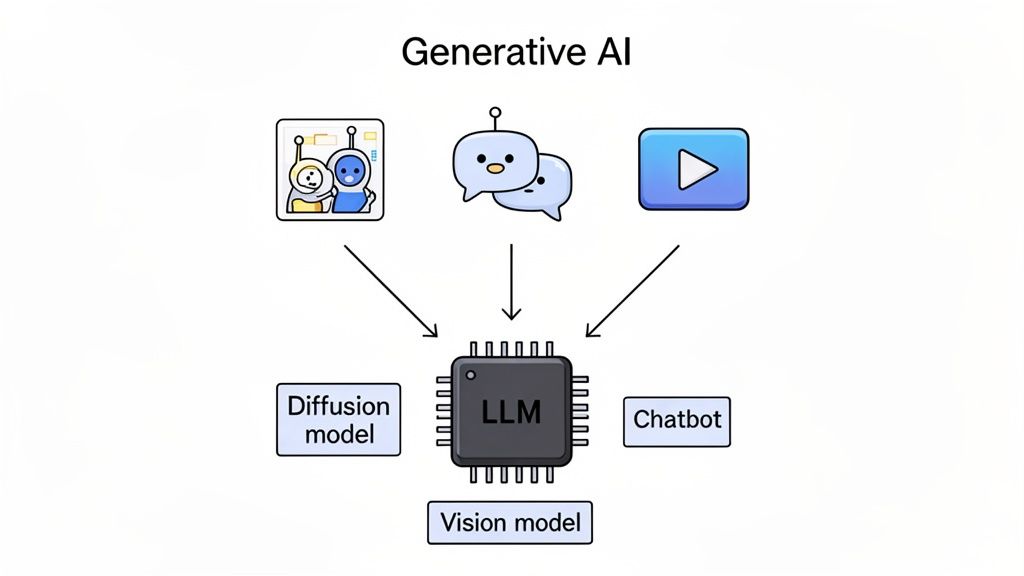
This teamwork is the magic behind the curtain of most AI tools you use. A single Generative AI platform, say for a marketing team, is probably juggling several specialized models to get the job done:
- It uses an LLM to brainstorm snappy ad copy or outline a blog post.
- It taps a diffusion model (a different kind of generative model) to whip up some stunning visuals for the campaign.
- It might even use a voice synthesis model to generate audio for a quick promotional video.
You, the user, are interacting with the Generative AI application. But the LLM is one of the most critical specialists in that entire workflow.
The Engine Room of Innovation
Understanding the difference between the final product (Generative AI) and the core tech (LLMs) is everything. For marketers, SEOs, and content creators, the big takeaway is this: you’re optimizing your content for the outputs of Generative AI systems. And those outputs are directly shaped by what the underlying LLMs are trained to value.
Here’s the core principle: LLMs are built to find and mimic patterns. They look for authority, clarity, and genuine usefulness. To get your content picked up and cited by a generative engine, it has to be the very definition of those qualities.
This is the kind of new reality we're dealing with. Just look at Perplexity, a generative answer engine that’s coming right for Google’s throat.
See how the whole experience is different? It's not about a list of ten blue links anymore. It’s about getting a single, sourced, and synthesized answer. This is the new arena where we fight for visibility, and it's powered by LLMs chewing through mountains of data to produce one definitive response.
The money pouring into this space is just staggering, which tells you this isn't a passing fad. Global spending on generative AI is on track to hit a mind-blowing $644 billion in 2025—that's a 76.4% jump from 2024. This spending frenzy shows that Generative AI, with LLMs firing on all cylinders in the engine room, is completely remaking the software game. If you want to dive deeper, you can check out more stats on the staggering growth of the LLM market on Hostinger.com.
Practical Differences That Shape Your Strategy
Alright, enough with the high-level theory. Let's get down to brass tacks. For anyone trying to build a brand or run a marketing team, the real meat in the generative AI vs LLMs debate is figuring out how their differences actually change your game plan. It’s less about what they are and more about what they do in the wild.
This isn't just a fun academic exercise—it dictates where you put your money, what your team works on, and the tools they use every day. If we break it down by Scope, Output, and Interaction, the whole picture snaps into focus.
Scope and Specialization
Think of Generative AI applications as the Swiss Army knives of creativity. They're built to be broad, versatile suites designed to tackle a whole bunch of content problems at once. Need a blog post? A few social media captions? A video script with some image ideas? A tool like Jasper is built for that—it’s an all-in-one content machine.
LLMs, however, are the master craftsmen. Their scope is incredibly deep but hyper-focused on one thing: language. An LLM like GPT-4, when you tap into it through an API, is pure, raw linguistic power. It’s a specialized resource for tasks that need a sophisticated grasp of text, not a shiny, ready-to-use product.
Output and Multimodality
This is where you see a massive split. Generative AI platforms are all about multimodal content. That’s a fancy way of saying they can spit out text, images, code, and sometimes even audio, all from one place. The whole point is to hand you a complete asset, ready to launch in a campaign.
LLMs are text nerds at heart. While the really advanced ones can understand images you feed them (multimodal input), their job is to generate words. You’d never ask a raw LLM to design your next logo. You’d use a Generative AI tool that probably has a specialized image model humming away under the hood for that specific job.
Key Insight: You use Generative AI as a product to make stuff. Your developers use an LLM as a foundational technology to build stuff. This simple distinction changes everything about how you budget for, strategize around, and implement AI.
User Interaction and Integration
How your team actually gets their hands on this tech is probably the biggest practical difference of all.
- Generative AI: You use it directly. A marketer logs into a slick dashboard, types a prompt into a friendly text box, and gets content back. It's a hands-on tool for creators.
- LLMs: The interaction here is almost always indirect, managed by developers through an API (Application Programming Interface). They weave the LLM's intelligence into your own software—like building a custom chatbot that sounds exactly like your brand, not like a generic robot.
Here’s a classic example. Your marketing team fires up a Generative AI platform to whip up a new social media campaign. In an hour, they have five different ad copy variations and ten unique images. It’s a direct, creative, hands-on task.
Meanwhile, your dev team is in a completely different world. They’re using an LLM via an API to build a new feature that automatically summarizes product reviews on your e-commerce site. This is a backend, data-crunching job that makes the customer's life better, but the customer never "sees" or "touches" the LLM itself. One is a creative partner; the other is a powerful engine bolted into your infrastructure.
Use Cases Where Each Technology Truly Shines
Alright, let's get out of the weeds of theory and into the real world. Knowing the difference between generative AI vs LLMs is great, but it's useless trivia if you don't know when to use which.
Think of it like a film crew. You've got your brilliant special effects artists who create mind-bending visuals, and you've got your sharp-witted screenwriters who craft unforgettable dialogue. You need both for a blockbuster, but you’d never ask the effects guru to write the script.
This is the exact fork in the road for your AI strategy. Are you trying to create something tangible your customers will see and interact with? Or are you building a smarter, faster process behind the scenes?
To make it dead simple, this decision tree maps out the core choice: go with a Generative AI application for creative, front-facing work, or tap into an LLM API for heavy-lifting backend tasks.
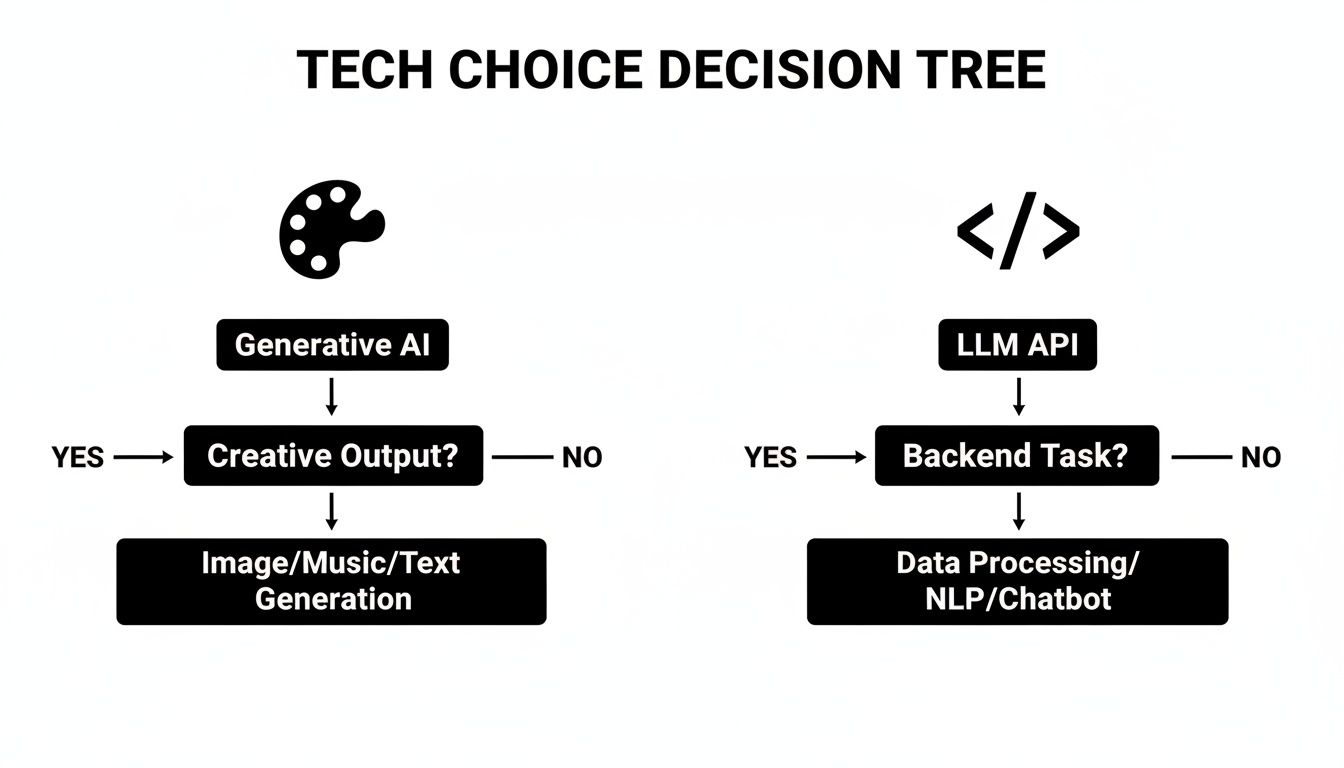
The image lays it out perfectly. Generative AI tools are what you use to make stuff. LLMs are the raw intelligence you build with.
When to Unleash Generative AI Applications
Generative AI platforms were born for the spotlight. These are the tools your marketing, content, and creative teams will have open in a browser tab all day, every day. Their magic lies in being immediately useful and churning out campaign-ready assets without needing a single line of code.
Here's where Generative AI is the obvious MVP:
- Spitballing Ad Copy: The team needs to A/B test ten different headlines for a new Facebook campaign, like, yesterday. A Generative AI tool can spin these up in seconds, playing with different emotional hooks and calls-to-action.
- Beating the Blank Page: That big, comprehensive guide on a new product feature isn't going to write itself. A Generative AI app can give you a solid outline and a first draft, basically cutting your writing time in half.
- Faking a Photoshoot: Your e-commerce brand needs slick lifestyle shots for a new sneaker line, but the photoshoot budget is...non-existent. Fire up a generative image tool and create dozens of unique, high-quality images of those sneakers in any setting you can imagine.
- Scripting Short-Form Video: The social media manager needs a punchy script for a 30-second promo video for the weekend sale. Generative AI can bang out the script, suggest visual cues, and even help storyboard the whole thing.
Where to Deploy LLMs for Backend Power
LLMs are the unsung heroes, the silent workhorses toiling away in the engine room. Developers integrate them to power intelligent systems, automate mind-numbingly complex processes, and pull meaningful insights out of mountains of text. You don't "log into" an LLM; you build on top of it.
Check out these backend power plays:
The Big Picture: Imagine an e-commerce brand using an LLM to automatically sort thousands of customer support tickets by issue (a classic backend LLM task). At the exact same time, their marketing team is using a Generative AI platform to create cool lifestyle images for the products people are ticketing about (a front-facing Generative AI task).
- Reading the Room at Scale: A product manager needs to know how people really feel about the latest software update. An LLM can chew through thousands of app store reviews and tweets, classifying sentiment and spotting recurring themes.
- Building an All-Knowing Internal Assistant: Your sales team is on a call and needs a super-specific technical answer, fast. An LLM can power an internal search tool that understands their plain-English questions and instantly pulls the right info from your dense company docs.
- Automating Painful Data Entry: The finance team is drowning in PDFs, manually pulling invoice numbers, dates, and amounts. An LLM-powered tool can scan and extract all that data automatically, freeing them from a task that drains the soul.
While the whole Generative AI market is on a rocket ship, projected to hit an eye-watering $1.3 trillion by 2032, LLMs have their own growing pains. A whopping 35% of users are wary of reliability issues like "hallucinations." This just hammers home why they're best suited for controlled, backend environments where outputs can be checked and validated. You can dig deeper into these user concerns and find more LLM reliability statistics on Hostinger.com.
Winning Visibility In The New Era Of AI Search
This is where the whole generative AI vs LLMs discussion stops being a fun bit of tech trivia and slams right into your marketing reality. Forget everything you thought you knew about climbing a list of ten blue links. The game has changed.
The future of search is about becoming the trusted source that a smart, LLM-powered answer engine decides to quote.
Welcome to the wild west of Generative Engine Optimization (GEO). Platforms like Perplexity and Google’s AI Overviews are the new frontier, and they couldn't care less about your old SEO rulebook. In this new arena, the top spot isn't a #1 ranking; it's getting your brand's name and insights woven directly into the AI's answer.
This requires a completely different way of thinking. Your old playbook—the one filled with keyword density tricks and backlink hunting—is gathering dust. LLMs don't just "crawl" your site. They devour it, digest it, and synthesize what they've learned into a single, confident response.
The Rise Of Invisible Competitors
One of the most mind-bending shifts is the appearance of what I call "invisible competitors." These are brands you've probably never seen on the first page of Google, yet they're absolutely dominating the AI-generated answers.
They're winning citations and shaping how customers think, all from behind the curtain. How? Because their content is basically a gourmet meal for an LLM. It's clear, factual, perfectly organized, and ridiculously easy to cite. They aren't just optimizing for a search bar; they're optimizing for the machine itself.
The new goal isn’t to rank; it’s to be sourced. You have to make your content so undeniably authoritative and clear that an LLM has no choice but to grab it and say, "This is the truth." That's the heart of Generative Engine Optimization.
For SEOs and growth marketers at agencies like Kruxel, getting seen inside generative engines like ChatGPT—which, by the way, has a staggering 501 million monthly users and a 74.2% market share—is no longer optional. If you want to dive deeper into the numbers, Hostinger.com has a great breakdown on the dominance of LLMs in search.
Optimizing For Traditional vs Generative Search
To win here, you have to evolve. You’re not just trying to please an algorithm that shuffles links around anymore. You're now feeding an intelligence that actually constructs answers from scratch.
Here’s a look at how the old world of SEO stacks up against the new reality of GEO.
| Optimization Focus | Traditional SEO | Generative Engine Optimization (GEO) |
|---|---|---|
| Primary Goal | Rank a URL high in search results. | Become a cited source in AI-generated answers. |
| Content Strategy | Target keywords and build backlinks. | Create citable facts, structured data, and clear expertise. |
| Key Metric | Keyword rankings and organic traffic. | Brand mentions and citation volume in AI responses. |
| Competitive Arena | Visible competitors on the search results page. | "Invisible" competitors who are sourced by the AI. |
Look, this doesn't mean you should throw your SEO efforts in the trash. It’s about expanding your strategy. The core principles—creating amazing, high-authority content—are more important than ever.
But the execution has to be surgically precise, with one question in mind: "How will an LLM understand and use this?" Your audience is no longer just the human on the other side of the screen; it's also the AI model learning from every word you write.
Your Playbook For Dominating Generative Engines
Knowing the difference between generative AI and LLMs is great for cocktail parties, but turning that knowledge into a weapon for visibility? That's a whole other ballgame. Winning in this new arena isn't about getting lucky. It’s about a deliberate, five-step strategy designed to play to how AI actually thinks.
This is your playbook for what we call Generative Engine Optimization (GEO). It’s a straightforward framework for making your brand the go-to source for AI-powered answers.
1. Master Prompt Intelligence
Forget everything you know about old-school keyword research. The new game in town is prompt intelligence. You have to get inside your audience's head and figure out the exact, conversational questions they're firing at generative engines.
This goes way beyond simple search terms. Think about the nuanced, multi-part queries people use when they're actually talking to an AI. You need tools that can uncover these conversational narratives so you know which ones to own.
2. Audit Your Content For AI Readiness
Right now, your existing content library is either a goldmine or a dead weight. It’s time for an honest AI-readiness audit. Go through your articles, guides, and reports and hunt for citable facts, hard data, and unique statistics.
Is your expertise easy to grab? Or is it buried in long, winding paragraphs? LLMs don't read for pleasure; they scan for data. If your best insights aren't structured with clear headings, lists, and tables, they're completely invisible to the machine.
The pressure to adapt is immense. A staggering 67% of organizations are already bringing LLMs into their operations, and the battle for who controls AI search narratives is getting fierce. This is about grabbing a slice of what’s projected to be an $82.1 billion LLM market by 2033. For a deeper dive into this explosive growth, check out the full LLM market research and insights on Hostinger.com.
3. Engineer "Rank Ready" Content
Now for the fun part: creating new content specifically built to be sourced by LLMs. This isn't your standard blog post. Rank-ready articles put factual density, clear attribution, and structured data front and center, leaving the fluffy storytelling behind.
Here’s what that looks like in practice:
- Lead with the data: Get your key statistics and unique insights right up top.
- Keep it simple: Ditch the corporate jargon and complex sentences.
- Structure for scanning: Use short paragraphs, bullet points, and tables liberally.
- Cite everything: Link out to authoritative primary sources to build machine trust.
4. Build Source Authority
LLMs are not created equal, and neither are websites in their eyes. These models are trained to recognize and prioritize information from domains they already consider authoritative—think major industry publications, respected research institutions, and top-tier media outlets.
Your outreach strategy needs a facelift. The new goal is to secure placements, mentions, and links from these high-trust domains. Getting your brand's data cited on a site an LLM already trusts is the ultimate shortcut to becoming a trusted source yourself.
5. Measure What Actually Matters
It’s time to break up with your old metrics. Obsessing over your position in the ten blue links is a waste of time. The new KPIs for generative search are all about your presence and influence inside the AI's answers.
Start tracking these numbers relentlessly:
- Brand Mentions: How often is your company name popping up in AI responses?
- Citation Volume: Are LLMs citing your website as a source for their claims?
- Share of Voice: Who’s really dominating the AI-generated answers for your most important topics?
This playbook is about moving from a passive observer to an active participant. It's how you stop reacting to AI and start telling it what to say about you.
Ready to stop guessing and start winning in AI search? Kruxel is the AI search visibility platform that gives you the playbook and the tools to dominate generative engines. See which competitors are stealing your citations, generate rank-ready content, and measure what truly matters. Start owning your AI narrative today.