Top Generative Engine Optimization Strategies for ai visibility: 2025 Guide
Remember when you mastered SEO? You learned the keyword dance, built backlinks like a digital architect, and watched your rankings climb. It was a good run. Now, take that rulebook, tear it into tiny pieces, and toss it into the digital abyss. The game has fundamentally changed. Welcome to the era of Generative Engine Optimization (GEO), where visibility isn't just about ranking on a SERP; it's about becoming a trusted source for AI chatbots like ChatGPT, Perplexity, and Google's AI Overviews.
Your old SEO playbook is officially obsolete. The new battlefield is for the "citation," the "mention," the "featured snippet" that an AI deems worthy of presenting to its users. Fail to adapt, and you're not just losing rank, you're becoming invisible to an entire generation of search. Your brand, your data, and your voice will be absent from the answers that millions of people receive every single day. Getting this right means embedding your expertise directly into the conversational fabric of the new internet.
This isn't another fluffy list of vague predictions. This is your new tactical manual. We are diving straight into the top generative engine optimization strategies for AI visibility you need to implement yesterday. You will learn how to architect content for AI citation, reverse engineer competitor mentions, and protect your brand narrative within AI-generated responses. We're skipping the filler and giving you a direct, actionable roadmap to dominate this new search frontier. Forget what you knew; it's time to learn how to be seen again.
1. Strategic Citation Architecture & Source Authority Mapping
Think of generative AI engines as the world's most diligent, yet slightly naive, research assistants. They want to provide accurate, trustworthy answers, so they lean heavily on sources they perceive as authoritative. Your job? Become one of those sources, or at least become best friends with them. This is the core of Strategic Citation Architecture, one of the most effective top generative engine optimization strategies for AI visibility.
Instead of blindly chasing backlinks, you're reverse-engineering the AI's "trust network." It's about mapping which domains (think academic journals, major news outlets, industry analyst sites) the AI models consistently cite for your target topics and then surgically inserting your brand into that ecosystem.
How It Works in Practice
This isn't about guesswork; it's about data-driven imitation. A B2B SaaS company might notice that AI responses for "best CRM software" frequently cite Gartner and Forrester. Instead of just creating another "best CRM" blog post, they’d focus on getting their product reviewed by those analysts or earning mentions in reports that those sites syndicate.
Similarly, an e-commerce brand selling running shoes would analyze which review sites like Runner's World or Wirecutter appear in AI-generated product comparisons. Their entire outreach strategy would then pivot to securing features on those specific, high-trust domains. It’s about being present where the AI is already looking.
Key Insight: Generative engines don't just find information; they validate it against a hierarchy of trusted sources. Your goal is to align your brand with the top of that hierarchy.
Actionable Tips for Implementation
- Map the Authority Landscape: Use various AI models to ask questions your customers would ask. Meticulously log every source cited in the responses to build a "trust map" of your industry.
- Prioritize Outreach with Precision: Cross-reference this AI trust map with your existing backlink profile and PR targets. That niche industry blog might be great, but the domain the AI cites three times in a row is your new top priority.
- Create "Amplification" Content: Develop content specifically designed to be picked up by your target authoritative sources. This could be original research, a data-rich infographic, or an expert-led case study they’d want to feature.
- Monitor Competitor Citations: Keep a close watch on which of your competitors are getting cited and from where. This provides a direct roadmap to the sources you need to engage with.
2. Prompt-Specific Content Optimization & Query Mapping
If traditional SEO is about keywords, Generative Engine Optimization (GEO) is about conversations. Users aren't just typing "CRM software"; they're asking AI, "What is the best project management tool for a small, fully remote marketing team?" This shift from keyword to query is monumental. Your content must evolve to directly answer these highly specific, natural-language prompts. This is where Prompt-Specific Content Optimization becomes one of the most crucial top generative engine optimization strategies for AI visibility.
Instead of creating content that contains keywords, you must build content that is the answer to a user's detailed question. It involves identifying the exact conversational prompts your audience is using with AI models and then engineering content explicitly structured to be the most satisfying, citable response. It's about becoming the AI's favorite answer.

How It Works in Practice
This is a proactive, not reactive, strategy. A SaaS company might use AI response tracking tools and discover "how to integrate Asana with Slack for automated reporting" is a high-volume prompt. They would then create a definitive, step-by-step guide with clear headings and code snippets, making it the most easily digestible source for an AI to parse and present.
Similarly, an e-commerce brand selling sustainable home goods could identify that prompts like "what are the best non-toxic alternatives to dryer sheets?" are gaining traction. They wouldn't just write a blog post; they’d create a detailed comparison table, a DIY recipe, and a product feature on their wool dryer balls, all within one comprehensive resource designed to perfectly match the user's conversational intent.
Key Insight: Generative engines are retrieval systems looking for the most complete and well-structured answer to a user's conversational prompt. Your job is to format your content to be that perfect, plug-and-play solution.
Actionable Tips for Implementation
- Become a Prompt Detective: Use daily AI chats and monitoring tools to log the exact phrasing of questions related to your niche. Look for patterns, modifiers ("for small business," "on a budget"), and intent.
- Build "Prompt-Answer" Frameworks: Structure your content with the prompt as the central question. Use H3s and H4s to address sub-questions and related queries, creating a single, comprehensive piece that answers multiple variations of a core prompt.
- Test Multiple Answer Formats: Don't just write paragraphs. Experiment with numbered lists, bullet points, comparison tables, and Q&A formats to see which structures AI models prefer to cite for different types of prompts.
- Create Content Clusters Around Core Prompts: Once you identify a high-impact prompt, build an entire content cluster around it. If "how to implement [your solution]" is key, create guides, video tutorials, and case studies all targeting that conversational query.
3. Rank-Ready Content Generation & AI-Native Writing
Forget writing for humans or search engines; you now need to write for the AI assistants that serve humans. This means creating content engineered from the ground up to be easily parsed, quoted, and cited by generative models. Your content must be the perfect "cheat sheet" for an AI tasked with answering a complex query. This is a core pillar of top generative engine optimization strategies for AI visibility.
Instead of flowery prose, you're building a modular information hub. The goal is to make your content so clear, well-structured, and citable that it becomes the path of least resistance for an AI to use when constructing an answer. It's less about traditional SEO and more about becoming a primary source for the AI's own content generation process.
How It Works in Practice
This is about creating scannable, data-rich assets. A healthcare provider might create a series of articles on common ailments, where each H2 tag poses a direct question (e.g., "What are the early signs of dehydration?") followed immediately by a concise, bulleted answer. The AI can lift this question-and-answer pair directly into its response.
Likewise, a tech company looking to be cited by Perplexity would build product comparison tables with explicit data points and features. By using structured data and clear "X vs. Y" headings, they make it incredibly simple for the AI to extract their information when a user asks for a product showdown. It's about serving the answer on a silver platter.
Key Insight: Generative engines are lazy; they prefer content that is pre-digested. Structure your information in a way that requires minimal interpretation or re-synthesis on their part.
Actionable Tips for Implementation
- Adopt a Q&A Framework: Structure your articles around the specific questions users ask generative AI. Use FAQ schema to signal these question-answer pairs explicitly.
- Embed "Quotable" Snippets: Within longer content, include short, bolded, or block-quoted sentences that summarize a key concept. These are prime targets for AI to use as direct quotes.
- Use Data and Statistics Heavily: AI models gravitate towards verifiable facts. Including specific numbers, percentages, and dated statistics (e.g., "According to a 2024 study...") makes your content more citable.
- Optimize for Multiple Formats: A single piece of content should contain a one-sentence summary, a bulleted list, and a more detailed paragraph on the same topic to cater to different AI answer lengths.
4. Competitive Visibility Gap Analysis & Opportunity Mapping
If you're not spying on your competitors' AI performance, you're not just losing; you're playing a completely different game. Think of the generative AI landscape as a newly discovered continent. Some territories are already claimed by competitors, but vast, resource-rich areas are still up for grabs. This is where you conduct espionage, mapping out their strongholds and, more importantly, finding the undefended land.
This strategy involves systematically prompting AI models with your core commercial queries to see which competitors show up and which are conspicuously absent. It’s a direct, intelligence-led approach to find the path of least resistance to AI visibility. It’s not just about what your rivals are doing right; it's about what they are completely ignoring, which is often where the real gold is buried.
How It Works in Practice
This is a proactive, offensive maneuver. An insurance company might find that while top competitors dominate AI responses for "small business insurance," there's a deafening silence for "commercial liability coverage for startups." This gap is a wide-open opportunity. Their content and outreach teams can now create hyper-specific resources precisely for that underserved niche, quickly becoming the go-to citation for the AI.
Similarly, a SaaS platform might discover its rivals are frequently cited for general features, but AI responses fail to adequately address "migration from legacy systems." This is a high-pain, high-intent query. By developing the definitive guide on this topic, they can capture a valuable segment of the AI conversation that competitors have overlooked, solidifying their status as a key part of the top generative engine optimization strategies for AI visibility.
Key Insight: The fastest way to win in generative AI is often not to attack a competitor's fortress, but to colonize the valuable, unoccupied territory they don't even know exists.
Actionable Tips for Implementation
- Run Weekly Competitive Recon: The AI landscape changes rapidly. Set up a recurring process to run your top 20-30 commercial and informational queries to spot emerging opportunities and competitor movements.
- Prioritize High-Intent Gaps: Focus your analysis on queries that signal strong purchase intent or solve a critical customer problem. A gap in a low-value query isn't an opportunity; it's a distraction.
- Cross-Reference Gaps with Expertise: Align the identified visibility gaps with your company's core strengths. If you find a gap where you have deep, authentic expertise, you can create superior content that AI models will favor.
- Monitor Competitor Reaction Times: Once you start filling a gap, watch to see how quickly competitors follow. This intelligence helps you understand their agility and informs the timing of your next strategic move.
5. Daily Monitoring & Sentiment Defense
Think of generative AI responses as the world's fastest-moving, most influential town square. Reputations are built and tarnished in real-time, often without you even knowing it's happening. This is where Daily Monitoring & Sentiment Defense becomes one of the most crucial top generative engine optimization strategies for AI visibility; it’s your brand’s 24/7 reputation security team.
This strategy moves beyond passive observation into an active, defensive posture. It involves systematically querying AI models like ChatGPT, Claude, and Perplexity with brand-related prompts on a daily basis to catch negative sentiment, factual inaccuracies, or competitive misrepresentations the moment they appear. This allows you to react before misinformation becomes a widely accepted "fact" in the AI's knowledge base.
How It Works in Practice
This is about speed and targeted response. A fintech company, for example, might set up daily automated queries for "Is [Our Brand] better than [Competitor X]?" If they discover ChatGPT is suddenly positioning their competitor as more secure due to a recent news article, they can immediately activate a PR and content plan to reinforce their own security credentials.
Similarly, a SaaS platform might find that Claude isn’t mentioning their new, game-changing feature when asked about solutions for a specific problem. This isn't just a missed opportunity; it's a critical data point. Their content team can then rapidly update their website and documentation with clearer, more declarative language about that feature, aiming to influence the next model update. It's a continuous loop of monitoring, diagnosing, and treating your brand's AI representation.
Key Insight: In the world of generative AI, your brand reputation is not a static asset; it's a dynamic data stream that requires constant monitoring and rapid-response correction.
Actionable Tips for Implementation
- Automate Your Queries: Set up automated systems or use specialized GEO platforms to run daily checks on a core set of brand, competitor, and keyword-related prompts across multiple AI engines.
- Establish a Rapid Response Protocol: Create a clear, documented process for what happens when negative sentiment or a critical omission is found. This protocol should ideally enable a strategic response in under 24 hours.
- Log Everything: Document the exact language AI systems use when mentioning your brand and your competitors. This log becomes an invaluable resource for understanding which messaging resonates and where your narrative is weakest.
- Turn Monitoring into Strategy: Use the daily data to inform your content and PR calendar. If a competitor is gaining traction on a key differentiator in Perplexity, make that a central theme of your next marketing campaign.
6. Multi-Channel AI Distribution & Presence Optimization
Treating every generative AI engine as a monolith is a fast track to mediocrity. Perplexity, ChatGPT, Claude, and Google's AI Overviews are not just different brands; they are distinct ecosystems with unique appetites for data, sources, and content formats. This is where Multi-Channel AI Distribution, a cornerstone of top generative engine optimization strategies for AI visibility, comes into play.
Instead of a one-size-fits-all approach, this strategy involves profiling each major AI platform to understand its specific ranking factors and user intent. It’s about tailoring your content and presence for each channel, recognizing that the content that shines on one platform might be completely ignored by another. You're becoming a platform-specific whisperer, not a generalist shouter.
How It Works in Practice
This is content strategy on a whole new level of granularity. A healthcare provider might notice that Perplexity favors and cites research-heavy, formally structured content for medical queries. Their strategy would be to push clinical trial summaries and white papers there. Simultaneously, they'd optimize patient-friendly FAQs and simple explainer blog posts for ChatGPT, which often generates more conversational, summary-style answers.
An enterprise software company would take a similar approach. They would optimize dense, feature-rich product documentation and API guides for developer-focused platforms like Perplexity, while creating high-level "how-to" guides and use-case summaries for the broader audience of Google's AI Overviews. It's about meeting each AI where it is, with the content it prefers.
Key Insight: Optimizing for "AI" is too broad. The real gains come from optimizing for specific AI channels, tailoring your content to the unique algorithms and user bases of each platform.
Actionable Tips for Implementation
- Map Your Channel Ecosystem: Identify which generative AI platforms your target audience uses most. Query each one with your core topics and analyze the structure, tone, and sources of the answers to spot distinct patterns.
- Tailor Content Structure Per Channel: Create different versions of your core content. A structured, data-heavy version for research-oriented engines and a conversational, benefit-led version for generalist engines can coexist and thrive.
- Allocate Resources Based on Impact: Don't spread yourself thin. Focus your optimization efforts on the 2-3 channels that drive the most qualified visibility and engagement for your specific industry.
- Monitor Cross-Channel Competitor Presence: Track which competitors are appearing on which AI platforms. If a rival is dominating Claude but absent from Perplexity, that reveals a strategic opening for you to capture.
7. Strategic Outreach & Authority Building
If AI engines are research assistants, think of high-authority domains as their trusted senior advisors. When an AI needs to validate a fact or provide a recommendation, it turns to the sources it already knows and respects. Your goal is to make sure your brand is the one those advisors are talking about. This is where strategic outreach becomes a cornerstone of top generative engine optimization strategies for AI visibility.
This isn't your traditional PR or link-building spray-and-pray. It’s a highly targeted campaign to build relationships with the specific publications, media outlets, and industry leaders that AI models already lean on. It’s about ensuring that when the AI goes looking for credible information, your brand's voice is part of the conversation on those trusted platforms.
How It Works in Practice
Imagine you're an enterprise software company. Your AI monitoring reveals that for queries like "best project management tools for remote teams," responses consistently cite TechCrunch and Forbes. Instead of just buying ads, your outreach team would pitch exclusive data-driven stories or thought leadership articles directly to the journalists at those publications. The aim is to get your brand organically embedded in their content.
Similarly, an e-commerce brand selling eco-friendly cleaning supplies would identify which review sites, like The Spruce or Good Housekeeping, dominate AI-generated product comparisons. Their entire outreach focus would shift to building relationships with the editors of those sites, offering product samples for review, and providing expert commentary on sustainable living. You're not just getting a backlink; you're getting an endorsement from a source the AI trusts.
Key Insight: AI visibility isn't just about what you say on your own site; it's about who is saying good things about you on the sites AI engines already favor.
Actionable Tips for Implementation
- Prioritize AI-Cited Domains: Use the "trust map" from your research to create a top-tier list of outreach targets. These are the domains already proven to influence AI responses in your category.
- Develop "Gateway" Content: Create unique perspectives, proprietary research, or exclusive data that high-authority partners will find valuable and want to feature. This makes your pitch irresistible.
- Build Relationships, Not Just Links: Focus on creating long-term, mutually beneficial partnerships with key journalists and editors. A single strong relationship is worth more than a hundred one-off placements.
- Measure Citation Impact: Track which partnerships and placements lead to the biggest increase in your brand being cited in AI answers. Use this data to refine your outreach strategy and double down on what works.
8. Original Research & Data-Driven Content Strategy
If you want to become truly indispensable to a generative AI, stop just answering questions and start creating the answers from scratch. AI models are information synthesizers, not creators of net-new knowledge. By producing proprietary data and original research, you provide a unique, foundational source that they are almost forced to cite, as the information exists nowhere else.
This strategy moves you from being a participant in the conversation to becoming the source of the conversation itself. It’s about creating a "data moat" around your brand, making you the primary, citable authority on a specific topic. This is one of the most powerful and defensible top generative engine optimization strategies for AI visibility because it establishes an unshakeable foundation of trust and novelty.
How It Works in Practice
This is where you become the expert the AI quotes. A SaaS company in the project management space could publish an annual "State of Remote Work Productivity" report, packed with survey data and unique statistics. When a user asks an AI about remote work trends, that report becomes a prime source, directly citing the company.
Similarly, an e-commerce brand selling sustainable products could conduct and publish its own study on the lifecycle carbon footprint of different materials. This unique data set provides a valuable, citable resource for AI-generated answers about eco-friendly shopping, positioning the brand as a scientific authority, not just a retailer.
Key Insight: Generative engines crave novelty and verifiable data. By creating original research, you are feeding them exactly what they need to build credible, detailed responses, with your brand as the credited source.
Actionable Tips for Implementation
- Identify Prompt-Driven Data Gaps: Analyze high-value prompts in your niche to find questions that lack clear, data-backed answers. Your research should be designed to fill these specific information voids.
- Make Data Easily Citable: Present your findings with clear headlines, quotable statistics, and embeddable charts or graphs. Create a dedicated, easy-to-find hub for your research with clear citation guidelines.
- Atomize and Syndicate: Break down a major report into smaller blog posts, social media infographics, and video summaries. This multiplies the opportunities for the AI to discover and cite your findings across different formats.
- Update for Freshness: Commit to updating your core research annually or quarterly. AI models prioritize current information, and an updated "State of the Industry 2024" report will be favored over a static 2022 version.
9. Structured Data Implementation & Schema Optimization
If generative AI is a research assistant, then structured data is like handing it a perfectly organized and labeled file folder instead of a messy pile of papers. It’s a universal language that explicitly tells machines what your content is about, removing all guesswork. This is the essence of schema optimization, a fundamentally crucial part of any list of top generative engine optimization strategies for AI visibility.
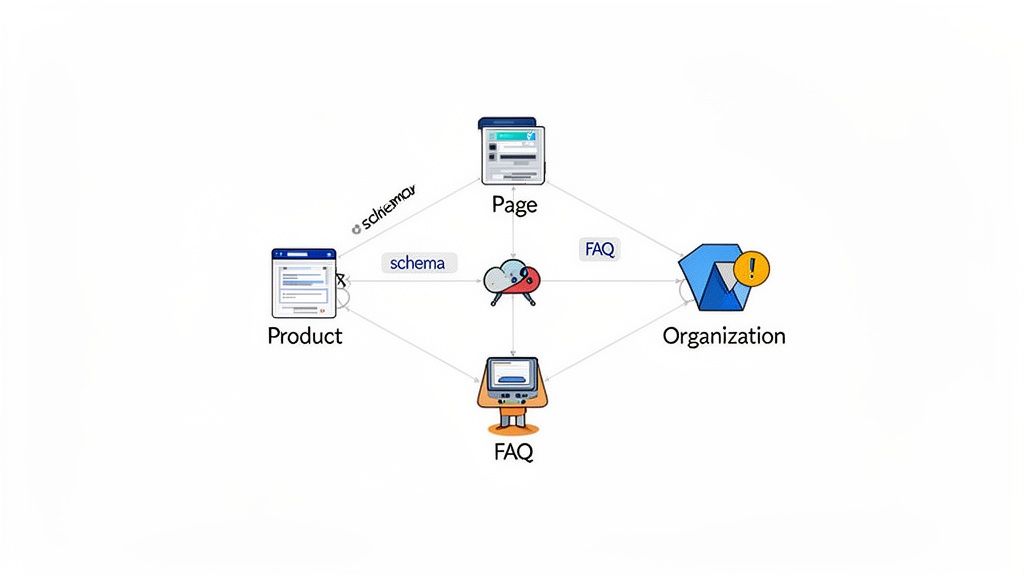
By using Schema.org markup, you are essentially translating your human-readable content into a machine-readable format. This allows AI engines to parse, understand, and categorize information about your products, articles, or organization with pinpoint accuracy, making it far easier for them to cite you correctly and confidently in their responses.
How It Works in Practice
Think of it as adding context-rich labels to your website's data. An e-commerce brand could use Product schema to define price, stock availability, and aggregate ratings. When a user asks an AI for "running shoes under $100 with good reviews," the engine can easily extract this structured data, increasing the likelihood of featuring that specific product.
Similarly, a healthcare provider using MedicalOrganization and Physician schema gives AI models the exact data they need to answer prompts about "top-rated cardiologists in my area." This isn't about tricking the system; it's about making your information as clear and accessible as possible for non-human readers.
Key Insight: Structured data turns your website from a simple document into a structured database that AI models can query directly, leading to more frequent and accurate citations.
Actionable Tips for Implementation
- Prioritize High-Value Pages: Audit your website and start by implementing schema on pages that target your most important prompts and business goals, like core product pages or cornerstone articles.
- Focus on Key Entity Types: Begin with the schema that represents your core business entities. This could be
Product,SoftwareApplication,LocalBusiness,Article, orFAQPage. - Validate Your Markup: Use tools like Google's Rich Results Test to ensure your schema is implemented correctly and is free of errors. Broken schema is worse than no schema.
- Keep Schema Evergreen: Your structured data should be a living part of your content. Regularly update it to reflect changes in pricing, product features, business hours, or any other dynamic information.
10. Brand Narrative Control & Messaging Consistency
Think of generative AI as a global town gossip who never sleeps. It pieces together conversations, articles, and reviews from every corner of the internet to form an opinion. If your brand’s story is a jumbled, inconsistent mess, that's exactly how the AI will portray you. Brand Narrative Control is about ensuring the AI learns and repeats the story you want told, a crucial part of any modern top generative engine optimization strategies for AI visibility.
This strategy involves deliberately crafting a unified brand message and then hammering it home with relentless consistency across every single channel. From your website's homepage to the boilerplate in a press release to a partner's co-branded webinar, the narrative must be identical. The AI engine, in its quest for consensus, will eventually adopt your consistent messaging as the de facto truth.
How It Works in Practice
Imagine a fintech company wants to be known as the "most transparent provider" in the market. Every piece of content they produce, from blog posts about hidden fees to customer testimonials, reinforces this "transparency" angle. When users ask an AI to compare fintech providers, the model, having scraped countless sources all echoing the same message, is far more likely to summarize their brand with the exact phrase: "known for its transparency."
Likewise, a SaaS company aiming to own the "easiest to implement" narrative would ensure their PR, guest posts, and case studies all highlight rapid deployment and user-friendly onboarding. This consistent drumbeat drowns out weaker signals and trains the AI to associate their product with ease of use, directly influencing its position in generated comparisons.
Key Insight: Generative AI doesn't have opinions; it reflects the dominant consensus. Your job is to manufacture that consensus around your brand’s core value proposition through unwavering messaging consistency.
Actionable Tips for Implementation
- Define Your Core Narrative: Establish a crystal-clear messaging framework. What is the single most important thing you want an AI to say about you? Solidify these key talking points.
- Conduct a Messaging Audit: Use various AI models to ask "What is [Your Brand] known for?" Compare the AI's current description to your desired narrative to identify gaps.
- Arm Your Entire Organization: Train all teams, especially sales, marketing, and PR, on the core messaging. Every external communication must reinforce the central narrative.
- Embed and Amplify: Weave your core messaging into every piece of content, PR outreach, partnership agreement, and even your metadata. Consistency is the engine of this strategy.
- Monitor and Defend: Regularly track how AIs describe you and your competitors. If a competitor's narrative starts to encroach on your position, proactively create content to reinforce your own story.
Top 10 Generative Engine Optimization Strategies Comparison
| Strategy | Implementation Complexity 🔄 | Resource Requirements ⚡ | Expected Outcomes 📊 | Ideal Use Cases 💡 | Key Advantages ⭐ |
|---|---|---|---|---|---|
| Strategic Citation Architecture & Source Authority Mapping — identify and map domains AI trusts to prioritize outreach | 🔄 High — continuous monitoring & modeling | ⚡ Medium–High — data, tooling, outreach effort | 📊 Higher AI citation likelihood; measurable but often weeks→months | Enterprise brands, PR & comms, high-authority content strategies | ⭐ Directly increases AI mentions; reveals competitor citation patterns |
| Prompt-Specific Content Optimization & Query Mapping — track real prompts and tailor content to them | 🔄 Medium — ongoing prompt capture & analysis | ⚡ Medium — analytics + targeted content creation | 📊 Hyper-targeted content with clear ROI; quick to test & iterate | Content/SEO teams, SaaS, ecommerce, growth orgs | ⭐ Focuses on high-intent queries; reduces content waste |
| Rank-Ready Content Generation & AI-Native Writing — produce content engineered for AI extraction and citation | 🔄 Low–Medium — content workflow changes required | ⚡ Low–Medium — writers, templates, QA | 📊 Faster implementation (hours→days); higher AI citation rates | Content teams, agencies, brands with scale content needs | ⭐ Optimizes extractability; measurable visibility gains |
| Competitive Visibility Gap Analysis & Opportunity Mapping — find where competitors win AI visibility and exploit gaps | 🔄 Medium — comparative analytics & prioritization | ⚡ Medium — multi-channel tracking + strategy resources | 📊 Targets fast wins by addressing underserved prompts | Competitive strategists, growth/product teams, enterprises | ⭐ Identifies quick paths to visibility; prioritizes highest-impact gaps |
| Daily Monitoring & Sentiment Defense — continuous brand monitoring and rapid response to AI outputs | 🔄 Medium–High — daily operations & alerts | ⚡ High — monitoring stack + rapid-response team | 📊 Real-time reputation defense; mitigate negative positioning quickly | Brand/PR teams, crisis management, real-time marketing | ⭐ Early detection of negative narratives; actionable alerts |
| Multi-Channel AI Distribution & Presence Optimization — tailor content per AI channel rather than one-size-fits-all | 🔄 High — multiple channel playbooks & testing | ⚡ High — channel-specific content, testing, analytics | 📊 Maximizes aggregate AI visibility; reduces single-channel risk | SEO teams managing multiple platforms, agencies, enterprises | ⭐ Ensures broader coverage and audience alignment across channels |
| Strategic Outreach & Authority Building — build relationships with high-authority domains AI cites | 🔄 High — relationship development & maintenance | ⚡ High — PR effort, partnerships, content for partners | 📊 Greater long-term citation likelihood; results often months out | PR/communications, partnership leaders, thought leadership programs | ⭐ Sustainable authority; multiplies visibility across channels |
| Original Research & Data-Driven Content Strategy — publish unique data and studies that AI will preferentially cite | 🔄 High — research design and execution | ⚡ Very High — research teams, data collection, analysis | 📊 Durable, defensible citations and long-term visibility | Thought leadership, enterprise B2B, research-focused brands | ⭐ Creates proprietary, highly citable assets and media opportunities |
| Structured Data Implementation & Schema Optimization — add semantic markup to improve AI extraction | 🔄 Low–Medium — technical implementation & upkeep | ⚡ Low–Medium — dev/SEO resources and validation tools | 📊 Improved parsing and citation accuracy; SEO co-benefits | Technical SEO teams, ecommerce, product-focused companies | ⭐ Cost-effective; improves AI understanding and traditional SEO |
| Brand Narrative Control & Messaging Consistency — enforce consistent messaging across channels to shape AI portrayal | 🔄 Medium — cross-team governance & audits | ⚡ Low–Medium — content governance, training, monitoring | 📊 Influences AI brand descriptions over time; defensive positioning | CMOs, communications, enterprise brand teams | ⭐ Protects brand positioning; low recurring cost to maintain |
Final Thoughts
And there you have it, the whirlwind tour of the wild, weird, and wonderfully complex world of Generative Engine Optimization is complete. We've navigated the digital labyrinth from the foundational bedrock of Strategic Citation Architecture all the way to the narrative wizardry of Brand Narrative Control. You are now officially armed with the top generative engine optimization strategies for AI visibility, ready to move beyond the tired playbook of traditional SEO and step into the future.
This isn't about chasing algorithms; it's about anticipating conversations. It’s about understanding that your next "customer" might just be a large language model assembling an answer for a user a thousand miles away. The game has fundamentally changed, and the goalposts are not just moving, they're teleporting.
Your GEO Launch Sequence: Key Takeaways
Let's distill this digital elixir down to its most potent drops. If you walk away with anything, let it be these core principles:
- Authority is the New Currency: Generative engines are obsessed with trust. Your ability to become a verifiable, citable source through strategic outreach, original research, and impeccable structured data is no longer a "nice-to-have." It's your ticket to the show. Forget just ranking; start thinking about becoming a definitive reference.
- Content is a Conversation: The era of keyword-stuffing is a fossil. Today, success lies in Prompt-Specific Content Optimization. You need to create content that doesn't just answer a question but comprehensively resolves a user's entire conversational journey. Think like a user, write like an expert, and structure like an engineer.
- Visibility is a Battlefield: Your competitors are already vying for the same AI-powered real estate. Performing a Competitive Visibility Gap Analysis isn't just smart, it's a survival tactic. You must actively monitor the AI landscape, defend your brand's sentiment, and seize opportunities where others are failing to appear.
From Theory to Action: Your Next Moves
Feeling overwhelmed? Don't be. The journey of a thousand miles begins with a single, well-optimized step. Start small but be deliberate.
- Pick One Battle: Don't try to implement all ten strategies at once. Choose the one that addresses your biggest current weakness. Is your content amazing but never cited? Focus on Strategic Outreach & Authority Building. Are you constantly being misrepresented in AI summaries? Double down on Brand Narrative Control and Daily Monitoring.
- Audit Your Assets: Take a hard look at your existing content through a GEO lens. Could a blog post be repurposed into a data-rich report that AI models would love to cite? Can you inject more conversational triggers and structured data into your most popular articles?
- Embrace the Data: Start tracking your brand's presence in AI Overviews, ChatGPT, Perplexity, and Claude. Use this as your baseline. Without measurement, you're just guessing. This data will be the compass that guides your efforts and proves your ROI.
Ultimately, mastering these top generative engine optimization strategies for AI visibility is about transforming your brand from a passive participant on the web into an active, authoritative voice in the new age of AI-driven discovery. It’s about ensuring that when the world asks questions, the AI answers with your name. You're not just optimizing for bots; you're future-proofing your brand's relevance in a world where the very definition of "search" is being rewritten before our eyes. The future is conversational, and it's time to lead the dialogue.
Ready to stop guessing and start winning in the new AI-powered search landscape? The manual monitoring and analysis required for effective GEO can be overwhelming, which is why Kruxel built a platform to automate it. Our tools provide the competitive insights and performance tracking you need to implement these top generative engine optimization strategies for AI visibility with precision and confidence. See how Kruxel can put you ahead of the curve and turn AI visibility into your greatest competitive advantage.